|
ScaLAPACK
2.0.2
ScaLAPACK: Scalable Linear Algebra PACKage
|
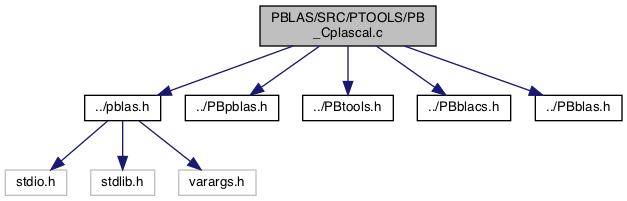
#include "../pblas.h"#include "../PBpblas.h"#include "../PBtools.h"#include "../PBblacs.h"#include "../PBblas.h"Go to the source code of this file.
Functions/Subroutines | |
| void | PB_Cplascal (PBTYP_T *TYPE, char *UPLO, char *CONJUG, int M, int N, char *ALPHA, char *A, int IA, int JA, int *DESCA) |
| void PB_Cplascal | ( | PBTYP_T * | TYPE, |
| char * | UPLO, | ||
| char * | CONJUG, | ||
| int | M, | ||
| int | N, | ||
| char * | ALPHA, | ||
| char * | A, | ||
| int | IA, | ||
| int | JA, | ||
| int * | DESCA | ||
| ) |

Definition at line 24 of file PB_Cplascal.c.
{
/*
* Purpose
* =======
*
* PB_Cplascal scales by alpha an m by n submatrix sub( A ) denoting
* A(IA:IA+M-1,JA:JA+N-1).
*
* Notes
* =====
*
* A description vector is associated with each 2D block-cyclicly dis-
* tributed matrix. This vector stores the information required to
* establish the mapping between a matrix entry and its corresponding
* process and memory location.
*
* In the following comments, the character _ should be read as
* "of the distributed matrix". Let A be a generic term for any 2D
* block cyclicly distributed matrix. Its description vector is DESC_A:
*
* NOTATION STORED IN EXPLANATION
* ---------------- --------------- ------------------------------------
* DTYPE_A (global) DESCA[ DTYPE_ ] The descriptor type.
* CTXT_A (global) DESCA[ CTXT_ ] The BLACS context handle, indicating
* the NPROW x NPCOL BLACS process grid
* A is distributed over. The context
* itself is global, but the handle
* (the integer value) may vary.
* M_A (global) DESCA[ M_ ] The number of rows in the distribu-
* ted matrix A, M_A >= 0.
* N_A (global) DESCA[ N_ ] The number of columns in the distri-
* buted matrix A, N_A >= 0.
* IMB_A (global) DESCA[ IMB_ ] The number of rows of the upper left
* block of the matrix A, IMB_A > 0.
* INB_A (global) DESCA[ INB_ ] The number of columns of the upper
* left block of the matrix A,
* INB_A > 0.
* MB_A (global) DESCA[ MB_ ] The blocking factor used to distri-
* bute the last M_A-IMB_A rows of A,
* MB_A > 0.
* NB_A (global) DESCA[ NB_ ] The blocking factor used to distri-
* bute the last N_A-INB_A columns of
* A, NB_A > 0.
* RSRC_A (global) DESCA[ RSRC_ ] The process row over which the first
* row of the matrix A is distributed,
* NPROW > RSRC_A >= 0.
* CSRC_A (global) DESCA[ CSRC_ ] The process column over which the
* first column of A is distributed.
* NPCOL > CSRC_A >= 0.
* LLD_A (local) DESCA[ LLD_ ] The leading dimension of the local
* array storing the local blocks of
* the distributed matrix A,
* IF( Lc( 1, N_A ) > 0 )
* LLD_A >= MAX( 1, Lr( 1, M_A ) )
* ELSE
* LLD_A >= 1.
*
* Let K be the number of rows of a matrix A starting at the global in-
* dex IA,i.e, A( IA:IA+K-1, : ). Lr( IA, K ) denotes the number of rows
* that the process of row coordinate MYROW ( 0 <= MYROW < NPROW ) would
* receive if these K rows were distributed over NPROW processes. If K
* is the number of columns of a matrix A starting at the global index
* JA, i.e, A( :, JA:JA+K-1, : ), Lc( JA, K ) denotes the number of co-
* lumns that the process MYCOL ( 0 <= MYCOL < NPCOL ) would receive if
* these K columns were distributed over NPCOL processes.
*
* The values of Lr() and Lc() may be determined via a call to the func-
* tion PB_Cnumroc:
* Lr( IA, K ) = PB_Cnumroc( K, IA, IMB_A, MB_A, MYROW, RSRC_A, NPROW )
* Lc( JA, K ) = PB_Cnumroc( K, JA, INB_A, NB_A, MYCOL, CSRC_A, NPCOL )
*
* Arguments
* =========
*
* TYPE (local input) pointer to a PBTYP_T structure
* On entry, TYPE is a pointer to a structure of type PBTYP_T,
* that contains type information (See pblas.h).
*
* UPLO (global input) pointer to CHAR
* On entry, UPLO specifies the part of the submatrix sub( A )
* to be scaled as follows:
* = 'L' or 'l': Lower triangular part is scaled; the
* strictly upper triangular part of sub( A ) is not changed;
* = 'U' or 'u': Upper triangular part is scaled; the
* strictly lower triangular part of sub( A ) is not changed;
* Otherwise: All of the submatrix sub( A ) is scaled.
*
* CONJUG (global input) pointer to CHAR
* On entry, CONJUG specifies what kind of scaling should be
* done as follows: when UPLO is 'L', 'l', 'U' or 'u' and CONJUG
* is 'Z' or 'z', alpha is assumed to be real and the imaginary
* part of the diagonals are set to zero. Otherwise, alpha is of
* the same type as the entries of sub( A ) and nothing particu-
* lar is done to the diagonals of sub( A ).
*
* M (global input) INTEGER
* On entry, M specifies the number of rows of the submatrix
* sub( A ). M must be at least zero.
*
* N (global input) INTEGER
* On entry, N specifies the number of columns of the submatrix
* sub( A ). N must be at least zero.
*
* ALPHA (global input) pointer to CHAR
* On entry, ALPHA specifies the scalar alpha, i.e., the cons-
* tant with which the matrix elements are to be scaled.
*
* A (local input/local output) pointer to CHAR
* On entry, A is an array of dimension (LLD_A, Ka), where Ka is
* at least Lc( 1, JA+N-1 ). Before entry, this array contains
* the local entries of the matrix A to be scaled. On exit, the
* local entries of this array corresponding to the to the en-
* tries of the submatrix sub( A ) are overwritten by the local
* entries of the m by n scaled submatrix.
*
* IA (global input) INTEGER
* On entry, IA specifies A's global row index, which points to
* the beginning of the submatrix sub( A ).
*
* JA (global input) INTEGER
* On entry, JA specifies A's global column index, which points
* to the beginning of the submatrix sub( A ).
*
* DESCA (global and local input) INTEGER array
* On entry, DESCA is an integer array of dimension DLEN_. This
* is the array descriptor for the matrix A.
*
* -- Written on April 1, 1998 by
* Antoine Petitet, University of Tennessee, Knoxville 37996, USA.
*
* ---------------------------------------------------------------------
*/
/*
* .. Local Scalars ..
*/
char UploA, herm, type;
int Acol, Arow, Aii, Aimb1, Ainb1, Ajj, Akp, Akq, Ald, Amb, Amp,
Amp0, Anb, Anq, Anq0, ctxt, izero=0, k, kb, ktmp, mn, mycol,
myrow, nb, npcol, nprow, size;
TZSCAL_T scal;
/*
* .. Local Arrays ..
*/
int Ad0[DLEN_];
char * Aptr = NULL;
/* ..
* .. Executable Statements ..
*
*/
/*
* Quick return if possible
*/
if( ( M <= 0 ) || ( N <= 0 ) ) return;
/*
* If alpha is zero, then call PB_Cplapad instead.
*/
type = TYPE->type;
UploA = Mupcase( UPLO[0] );
herm = ( UploA == CALL ? CNOCONJG : Mupcase( CONJUG[0] ) );
if( type == SREAL )
{
if( ((float*)(ALPHA))[REAL_PART] == ZERO )
{
PB_Cplapad( TYPE, UPLO, NOCONJG, M, N, TYPE->zero, TYPE->zero, A, IA,
JA, DESCA );
return;
}
else if( ((float*)(ALPHA))[REAL_PART] == ONE ) return;
}
else if( type == DREAL )
{
if( ((double*)(ALPHA))[REAL_PART] == ZERO )
{
PB_Cplapad( TYPE, UPLO, NOCONJG, M, N, TYPE->zero, TYPE->zero, A, IA,
JA, DESCA );
return;
}
else if( ((double*)(ALPHA))[REAL_PART] == ONE ) return;
}
else if( type == SCPLX )
{
if( herm == CCONJG )
{
if( ((float*)(ALPHA))[REAL_PART] == ZERO )
{
PB_Cplapad( TYPE, UPLO, NOCONJG, M, N, TYPE->zero, TYPE->zero, A,
IA, JA, DESCA );
return;
}
}
else
{
if( ((float*)(ALPHA))[IMAG_PART] == ZERO )
{
if( ((float*)(ALPHA))[REAL_PART] == ZERO )
{
PB_Cplapad( TYPE, UPLO, NOCONJG, M, N, TYPE->zero, TYPE->zero, A,
IA, JA, DESCA );
return;
}
else if( ((float*)(ALPHA))[REAL_PART] == ONE ) return;
}
}
}
else if( type == DCPLX )
{
if( herm == CCONJG )
{
if( ((double*)(ALPHA))[REAL_PART] == ZERO )
{
PB_Cplapad( TYPE, UPLO, NOCONJG, M, N, TYPE->zero, TYPE->zero, A,
IA, JA, DESCA );
return;
}
}
else
{
if( ((double*)(ALPHA))[IMAG_PART] == ZERO )
{
if( ((double*)(ALPHA))[REAL_PART] == ZERO )
{
PB_Cplapad( TYPE, UPLO, NOCONJG, M, N, TYPE->zero, TYPE->zero, A,
IA, JA, DESCA );
return;
}
else if( ((double*)(ALPHA))[REAL_PART] == ONE ) return;
}
}
}
/*
* Retrieve process grid information
*/
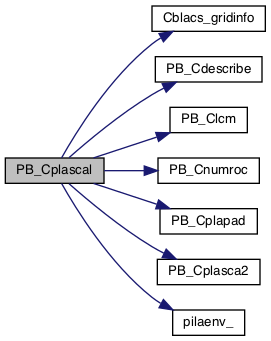
Cblacs_gridinfo( ( ctxt = DESCA[CTXT_] ), &nprow, &npcol, &myrow, &mycol );
/*
* Compute descriptor Ad0 for sub( A )
*/
PB_Cdescribe( M, N, IA, JA, DESCA, nprow, npcol, myrow, mycol, &Aii, &Ajj,
&Ald, &Aimb1, &Ainb1, &Amb, &Anb, &Arow, &Acol, Ad0 );
/*
* Quick return if I don't own any of sub( A ).
*/
Amp = PB_Cnumroc( M, 0, Aimb1, Amb, myrow, Arow, nprow );
Anq = PB_Cnumroc( N, 0, Ainb1, Anb, mycol, Acol, npcol );
if( ( Amp <= 0 ) || ( Anq <= 0 ) ) return;
size = TYPE->size;
scal = ( herm == CCONJG ? TYPE->Fhescal : TYPE->Ftzscal );
Aptr = Mptr( A, Aii, Ajj, Ald, size );
/*
* When the entire sub( A ) needs to be scaled or when sub( A ) is replicated in
* all processes, just call the local routine.
*/
if( ( Mupcase( UPLO[0] ) == CALL ) ||
( ( ( Arow < 0 ) || ( nprow == 1 ) ) &&
( ( Acol < 0 ) || ( npcol == 1 ) ) ) )
{
scal( C2F_CHAR( UPLO ), &Amp, &Anq, &izero, ALPHA, Aptr, &Ald );
return;
}
/*
* Computational partitioning size is computed as the product of the logical
* value returned by pilaenv_ and two times the least common multiple of nprow
* and npcol.
*/
nb = 2 * pilaenv_( &ctxt, C2F_CHAR( &type ) ) *
PB_Clcm( ( Arow >= 0 ? nprow : 1 ), ( Acol >= 0 ? npcol : 1 ) );
mn = MIN( M, N );
if( Mupcase( UPLO[0] ) == CLOWER )
{
/*
* Lower triangle of sub( A ): proceed by block of columns. For each block of
* columns, operate on the logical diagonal block first and then the remaining
* rows of that block of columns.
*/
for( k = 0; k < mn; k += nb )
{
kb = mn - k; ktmp = k + ( kb = MIN( kb, nb ) );
PB_Cplasca2( TYPE, UPLO, CONJUG, kb, kb, ALPHA, Aptr, k, k, Ad0 );
Akp = PB_Cnumroc( ktmp, 0, Aimb1, Amb, myrow, Arow, nprow );
Akq = PB_Cnumroc( k, 0, Ainb1, Anb, mycol, Acol, npcol );
Anq0 = PB_Cnumroc( kb, k, Ainb1, Anb, mycol, Acol, npcol );
if( ( Amp0 = Amp - Akp ) > 0 )
scal( C2F_CHAR( ALL ), &Amp0, &Anq0, &izero, ALPHA, Mptr( Aptr,
Akp, Akq, Ald, size ), &Ald );
}
}
else if( Mupcase( UPLO[0] ) == CUPPER )
{
/*
* Upper triangle of sub( A ): proceed by block of columns. For each block of
* columns, operate on the trailing rows and then the logical diagonal block
* of that block of columns. When M < N, the last columns of sub( A ) are
* handled together.
*/
for( k = 0; k < mn; k += nb )
{
kb = mn - k; kb = MIN( kb, nb );
Akp = PB_Cnumroc( k, 0, Aimb1, Amb, myrow, Arow, nprow );
Akq = PB_Cnumroc( k, 0, Ainb1, Anb, mycol, Acol, npcol );
Anq0 = PB_Cnumroc( kb, k, Ainb1, Anb, mycol, Acol, npcol );
if( Akp > 0 )
scal( C2F_CHAR( ALL ), &Akp, &Anq0, &izero, ALPHA, Mptr( Aptr,
0, Akq, Ald, size ), &Ald );
PB_Cplasca2( TYPE, UPLO, CONJUG, kb, kb, ALPHA, Aptr, k, k, Ad0 );
}
if( ( Anq -= ( Akq += Anq0 ) ) > 0 )
scal( C2F_CHAR( ALL ), &Amp, &Anq, &izero, ALPHA, Mptr( Aptr, 0,
Akq, Ald, size ), &Ald );
}
else
{
/*
* All of sub( A ): proceed by block of columns. For each block of columns,
* operate on the trailing rows, then the logical diagonal block, and finally
* the remaining rows of that block of columns. When M < N, the last columns
* of sub( A ) are handled together.
*/
for( k = 0; k < mn; k += nb )
{
kb = mn - k; kb = MIN( kb, nb );
Akp = PB_Cnumroc( k, 0, Aimb1, Amb, myrow, Arow, nprow );
Akq = PB_Cnumroc( k, 0, Ainb1, Anb, mycol, Acol, npcol );
Anq0 = PB_Cnumroc( kb, k, Ainb1, Anb, mycol, Acol, npcol );
if( Akp > 0 )
scal( C2F_CHAR( ALL ), &Akp, &Anq0, &izero, ALPHA, Mptr( Aptr,
0, Akq, Ald, size ), &Ald );
PB_Cplasca2( TYPE, UPLO, NOCONJG, kb, kb, ALPHA, Aptr, k, k, Ad0 );
Akp = PB_Cnumroc( k+kb, 0, Aimb1, Amb, myrow, Arow, nprow );
if( ( Amp0 = Amp - Akp ) > 0 )
scal( C2F_CHAR( ALL ), &Amp0, &Anq0, &izero, ALPHA, Mptr( Aptr,
Akp, Akq, Ald, size ), &Ald );
}
if( ( Anq -= ( Akq += Anq0 ) ) > 0 )
scal( C2F_CHAR( ALL ), &Amp, &Anq, &izero, ALPHA, Mptr( Aptr, 0,
Akq, Ald, size ), &Ald );
}
/*
* End of PB_Cplascal
*/
}