|
ScaLAPACK
2.0.2
ScaLAPACK: Scalable Linear Algebra PACKage
|
#include "redist.h"#include <stdio.h>#include <stdlib.h>#include <assert.h>Go to the source code of this file.
Data Types | |
| struct | dcomplex |
| struct | MDESC |
| struct | IDESC |
Defines | |
| #define | static2 static |
| #define | fortran_mr2d pztrmr2do |
| #define | fortran_mr2dnew pztrmr2d |
| #define | zcopy_ zcopy |
| #define | zlacpy_ zlacpy |
| #define | Clacpy Cztrlacpy |
| #define | BLOCK_CYCLIC_2D 1 |
| #define | SHIFT(row, sprow, nbrow) ((row)-(sprow)+ ((row) >= (sprow) ? 0 : (nbrow))) |
| #define | max(A, B) ((A)>(B)?(A):(B)) |
| #define | min(A, B) ((A)>(B)?(B):(A)) |
| #define | DIVUP(a, b) ( ((a)-1) /(b)+1) |
| #define | ROUNDUP(a, b) (DIVUP(a,b)*(b)) |
| #define | scanD0 ztrscanD0 |
| #define | dispmat ztrdispmat |
| #define | setmemory ztrsetmemory |
| #define | freememory ztrfreememory |
| #define | scan_intervals ztrscan_intervals |
| #define | SENDBUFF 0 |
| #define | RECVBUFF 1 |
| #define | SIZEBUFF 2 |
| #define | NDEBUG |
| #define | DESCLEN 9 |
| #define | NBPARAM 20 |
| #define | MAGIC_MAX 100000000 |
Functions/Subroutines | |
| void | Clacpy () |
| void | Cblacs_pcoord () |
| int | Cblacs_pnum () |
| void | Csetpvmtids () |
| void | Cblacs_get () |
| void | Cblacs_pinfo () |
| void | Cblacs_gridinfo () |
| void | Cblacs_gridinit () |
| void | Cblacs_exit () |
| void | Cblacs_gridexit () |
| void | Cblacs_setup () |
| void | Cigebs2d () |
| void | Cigebr2d () |
| void | Cigesd2d () |
| void | Cigerv2d () |
| void | Cigsum2d () |
| void | Cigamn2d () |
| void | Cigamx2d () |
| void | Czgesd2d () |
| void | Czgerv2d () |
| void | zlacpy_ () |
| int | localindice () |
| void * | mr2d_malloc () |
| int | ppcm () |
| int | localsize () |
| int | memoryblocksize () |
| int | changeorigin () |
| void | paramcheck () |
| void | scanD0 () |
| void | dispmat () |
| void | setmemory () |
| void | freememory () |
| int | scan_intervals () |
| void | Cpztrmr2do () |
| void | Cpztrmr2d () |
| void | fortran_mr2d (char *uplo, char *diag, int *m, int *n, dcomplex *A, int *ia, int *ja, desc_A, dcomplex *B, int *ib, int *jb, desc_B) |
| void | fortran_mr2dnew (char *uplo, char *diag, int *m, int *n, dcomplex *A, int *ia, int *ja, desc_A, dcomplex *B, int *ib, int *jb, desc_B, int *gcontext) |
| static2 void | init_chenille () |
| static2 int | inter_len () |
| static2 int | block2buff () |
| static2 void | buff2block () |
| static2 void | gridreshape () |
| void | Cpztrmr2do (char *uplo, char *diag, int m, int n, dcomplex *ptrmyblock, int ia, int ja, MDESC *ma, dcomplex *ptrmynewblock, int ib, int jb, MDESC *mb) |
| void | Cpztrmr2d (char *uplo, char *diag, int m, int n, dcomplex *ptrmyblock, int ia, int ja, MDESC *ma, dcomplex *ptrmynewblock, int ib, int jb, MDESC *mb, int globcontext) |
| static2 void | init_chenille (int mypnum, int nprocs, int n0, int *proc0, int n1, int *proc1, int **psend, int **precv, int *myrang) |
| void | Clacpy (int m, int n, dcomplex *a, int lda, dcomplex *b, int ldb) |
| static2 void | gridreshape (int *ctxtp) |
| #define SHIFT | ( | row, | |
| sprow, | |||
| nbrow | |||
| ) | ((row)-(sprow)+ ((row) >= (sprow) ? 0 : (nbrow))) |
| #define static2 static |
------------------------------------------------------------------------
-- ScaLAPACK routine (version 1.7) -- Oak Ridge National Laboratory, Univ. of Tennessee, and Univ. of California, Berkeley. October 31, 1994.
SUBROUTINE PZTRMR2D(UPLO, DIAG, M, N, $ A, IA, JA, ADESC, $ B, IB, JB, BDESC, $ CTXT) ------------------------------------------------------------------------ Purpose =======
PZTRMR2D copies a submatrix of A on a submatrix of B. A and B can have different distributions: they can be on different processor grids, they can have different blocksizes, the beginning of the area to be copied can be at a different places on A and B.
The parameters can be confusing when the grids of A and B are partially or completly disjoint, in the case a processor calls this routines but is either not in the A context or B context, the ADESC[CTXT] or BDESC[CTXT] must be equal to -1, to ensure the routine recognise this situation. To summarize the rule:
The submatrix to be copied is assumed to be trapezoidal. So only the upper or the lower part will be copied. The other part is unchanged.
Notes =====
A description vector is associated with each 2D block-cyclicly dis- tributed matrix. This vector stores the information required to establish the mapping between a matrix entry and its corresponding process and memory location.
In the following comments, the character _ should be read as "of the distributed matrix". Let A be a generic term for any 2D block cyclicly distributed matrix. Its description vector is DESC_A:
NOTATION STORED IN EXPLANATION --------------- -------------- -------------------------------------- DT_A (global) DESCA( DT_ ) The descriptor type. CTXT_A (global) DESCA( CTXT_ ) The BLACS context handle, indicating the BLACS process grid A is distribu- ted over. The context itself is glo- bal, but the handle (the integer value) may vary. M_A (global) DESCA( M_ ) The number of rows in the distributed matrix A. N_A (global) DESCA( N_ ) The number of columns in the distri- buted matrix A. MB_A (global) DESCA( MB_ ) The blocking factor used to distribute the rows of A. NB_A (global) DESCA( NB_ ) The blocking factor used to distribute the columns of A. RSRC_A (global) DESCA( RSRC_ ) The process row over which the first row of the matrix A is distributed. CSRC_A (global) DESCA( CSRC_ ) The process column over which the first column of A is distributed. LLD_A (local) DESCA( LLD_ ) The leading dimension of the local array storing the local blocks of the distributed matrix A. LLD_A >= MAX(1,LOCp(M_A)).
Important notice ================ The parameters of the routine have changed in April 1996 There is a new last argument. It must be a context englobing all processors involved in the initial and final distribution.
Be aware that all processors included in this context must call the redistribution routine.
Parameters ==========
UPLO (input) CHARACTER*1. On entry, UPLO specifies whether we should copy the upper part of the lower part of the defined submatrix: UPLO = 'U' or 'u' copy the upper triangular part. UPLO = 'L' or 'l' copy the lower triangular part. Unchanged on exit.
DIAG (input) CHARACTER*1. On entry, DIAG specifies whether we should copy the diagonal. DIAG = 'U' or 'u' do NOT copy the diagonal of the submatrix. DIAG = 'N' or 'n' DO copy the diagonal of the submatrix. Unchanged on exit.
M (input) INTEGER. On entry, M specifies the number of rows of the submatrix to be copied. M must be at least zero. Unchanged on exit.
N (input) INTEGER. On entry, N specifies the number of cols of the submatrix to be redistributed.rows of B. M must be at least zero. Unchanged on exit.
A (input) COMPLEX*16 On entry, the source matrix. Unchanged on exit.
IA,JA (input) INTEGER On entry,the coordinates of the beginning of the submatrix of A to copy. 1 <= IA <= M_A - M + 1,1 <= JA <= N_A - N + 1, Unchanged on exit.
ADESC (input) A description vector (see Notes above) If the current processor is not part of the context of A the ADESC[CTXT] must be equal to -1.
B (output) COMPLEX*16 On entry, the destination matrix. The portion corresponding to the defined submatrix are updated.
IB,JB (input) INTEGER On entry,the coordinates of the beginning of the submatrix of B that will be updated. 1 <= IB <= M_B - M + 1,1 <= JB <= N_B - N + 1, Unchanged on exit.
BDESC (input) B description vector (see Notes above) For processors not part of the context of B BDESC[CTXT] must be equal to -1.
CTXT (input) a context englobing at least all processors included in either A context or B context
Memory requirement : ====================
for the processors belonging to grid 0, one buffer of size block 0 and for the processors belonging to grid 1, also one buffer of size block 1.
============================================================ Created March 1993 by B. Tourancheau (See sccs for modifications). Modifications by Loic PRYLLI 1995 ============================================================
| static2 int block2buff | ( | ) |
| static2 void buff2block | ( | ) |
| void Cblacs_exit | ( | ) |
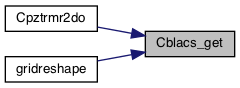
| void Cblacs_get | ( | ) |
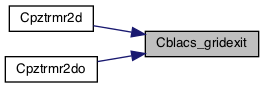
| void Cblacs_gridexit | ( | ) |
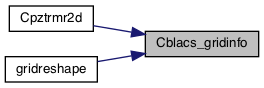
| void Cblacs_gridinfo | ( | ) |
| void Cblacs_gridinit | ( | ) |
| void Cblacs_pcoord | ( | ) |
| void Cblacs_pinfo | ( | ) |
| int Cblacs_pnum | ( | ) |
| void Cblacs_setup | ( | ) |
| int changeorigin | ( | ) |
| void Cigamn2d | ( | ) |
| void Cigamx2d | ( | ) |
| void Cigebr2d | ( | ) |
| void Cigebs2d | ( | ) |
| void Cigerv2d | ( | ) |
| void Cigesd2d | ( | ) |
| void Cigsum2d | ( | ) |
| void Clacpy | ( | ) |
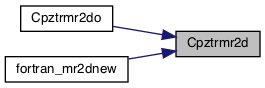
| void Cpztrmr2d | ( | ) |
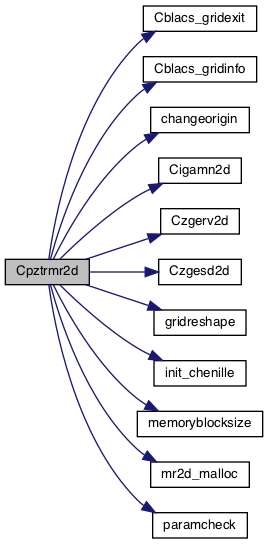
| void Cpztrmr2d | ( | char * | uplo, |
| char * | diag, | ||
| int | m, | ||
| int | n, | ||
| dcomplex * | ptrmyblock, | ||
| int | ia, | ||
| int | ja, | ||
| MDESC * | ma, | ||
| dcomplex * | ptrmynewblock, | ||
| int | ib, | ||
| int | jb, | ||
| MDESC * | mb, | ||
| int | globcontext | ||
| ) |
Definition at line 317 of file pztrmr.c.
{
dcomplex *ptrsendbuff, *ptrrecvbuff, *ptrNULL = 0;
dcomplex *recvptr;
MDESC newa, newb;
int *proc0, *proc1, *param;
int mypnum, myprow0, mypcol0, myprow1, mypcol1, nprocs;
int i, j;
int nprow, npcol, gcontext;
int recvsize, sendsize;
IDESC *h_inter; /* to store the horizontal intersections */
IDESC *v_inter; /* to store the vertical intersections */
int hinter_nb, vinter_nb; /* number of intrsections in both directions */
int dummy;
int p0, q0, p1, q1;
int *ra, *ca;
/* end of variables */
/* To simplify further calcul we change the matrix indexation from
* 1..m,1..n (fortran) to 0..m-1,0..n-1 */
if (m == 0 || n == 0)
return;
ia -= 1;
ja -= 1;
ib -= 1;
jb -= 1;
Cblacs_gridinfo(globcontext, &nprow, &npcol, &dummy, &mypnum);
gcontext = globcontext;
nprocs = nprow * npcol;
/* if the global context that is given to us has not the shape of a line
* (nprow != 1), create a new context. TODO: to be optimal, we should
* avoid this because it is an uncessary synchronisation */
if (nprow != 1) {
gridreshape(&gcontext);
Cblacs_gridinfo(gcontext, &dummy, &dummy, &dummy, &mypnum);
}
Cblacs_gridinfo(ma->ctxt, &p0, &q0, &myprow0, &mypcol0);
/* compatibility T3D, must check myprow and mypcol are within bounds */
if (myprow0 >= p0 || mypcol0 >= q0)
myprow0 = mypcol0 = -1;
assert((myprow0 < p0 && mypcol0 < q0) || (myprow0 == -1 && mypcol0 == -1));
Cblacs_gridinfo(mb->ctxt, &p1, &q1, &myprow1, &mypcol1);
if (myprow1 >= p1 || mypcol1 >= q1)
myprow1 = mypcol1 = -1;
assert((myprow1 < p1 && mypcol1 < q1) || (myprow1 == -1 && mypcol1 == -1));
/* exchange the missing parameters among the processors: shape of grids and
* location of the processors */
param = (int *) mr2d_malloc(3 * (nprocs * 2 + NBPARAM) * sizeof(int));
ra = param + nprocs * 2 + NBPARAM;
ca = param + (nprocs * 2 + NBPARAM) * 2;
for (i = 0; i < nprocs * 2 + NBPARAM; i++)
param[i] = MAGIC_MAX;
proc0 = param + NBPARAM;
proc1 = param + NBPARAM + nprocs;
/* we calulate proc0 and proc1 that will give the number of a proc in
* respectively a or b in the global context */
if (myprow0 >= 0) {
proc0[myprow0 * q0 + mypcol0] = mypnum;
param[0] = p0;
param[1] = q0;
param[4] = ma->m;
param[5] = ma->n;
param[6] = ma->nbrow;
param[7] = ma->nbcol;
param[8] = ma->sprow;
param[9] = ma->spcol;
param[10] = ia;
param[11] = ja;
}
if (myprow1 >= 0) {
proc1[myprow1 * q1 + mypcol1] = mypnum;
param[2] = p1;
param[3] = q1;
param[12] = mb->m;
param[13] = mb->n;
param[14] = mb->nbrow;
param[15] = mb->nbcol;
param[16] = mb->sprow;
param[17] = mb->spcol;
param[18] = ib;
param[19] = jb;
}
Cigamn2d(gcontext, "All", "H", 2 * nprocs + NBPARAM, 1, param, 2 * nprocs + NBPARAM,
ra, ca, 2 * nprocs + NBPARAM, -1, -1);
newa = *ma;
newb = *mb;
ma = &newa;
mb = &newb;
if (myprow0 == -1) {
p0 = param[0];
q0 = param[1];
ma->m = param[4];
ma->n = param[5];
ma->nbrow = param[6];
ma->nbcol = param[7];
ma->sprow = param[8];
ma->spcol = param[9];
ia = param[10];
ja = param[11];
}
if (myprow1 == -1) {
p1 = param[2];
q1 = param[3];
mb->m = param[12];
mb->n = param[13];
mb->nbrow = param[14];
mb->nbcol = param[15];
mb->sprow = param[16];
mb->spcol = param[17];
ib = param[18];
jb = param[19];
}
for (i = 0; i < NBPARAM; i++) {
if (param[i] == MAGIC_MAX) {
fprintf(stderr, "xxGEMR2D:something wrong in the parameters\n");
exit(1);
}
}
#ifndef NDEBUG
for (i = 0; i < p0 * q0; i++)
assert(proc0[i] >= 0 && proc0[i] < nprocs);
for (i = 0; i < p1 * q1; i++)
assert(proc1[i] >= 0 && proc1[i] < nprocs);
#endif
/* check the validity of the parameters */
paramcheck(ma, ia, ja, m, n, p0, q0, gcontext);
paramcheck(mb, ib, jb, m, n, p1, q1, gcontext);
/* we change the problem so that ia < a->nbrow ... andia + m = a->m ... */
{
int decal;
ia = changeorigin(myprow0, ma->sprow, p0,
ma->nbrow, ia, &decal, &ma->sprow);
ptrmyblock += decal;
ja = changeorigin(mypcol0, ma->spcol, q0,
ma->nbcol, ja, &decal, &ma->spcol);
ptrmyblock += decal * ma->lda;
ma->m = ia + m;
ma->n = ja + n;
ib = changeorigin(myprow1, mb->sprow, p1,
mb->nbrow, ib, &decal, &mb->sprow);
ptrmynewblock += decal;
jb = changeorigin(mypcol1, mb->spcol, q1,
mb->nbcol, jb, &decal, &mb->spcol);
ptrmynewblock += decal * mb->lda;
mb->m = ib + m;
mb->n = jb + n;
if (p0 == 1)
ma->nbrow = ma->m;
if (q0 == 1)
ma->nbcol = ma->n;
if (p1 == 1)
mb->nbrow = mb->m;
if (q1 == 1)
mb->nbcol = mb->n;
#ifndef NDEBUG
paramcheck(ma, ia, ja, m, n, p0, q0, gcontext);
paramcheck(mb, ib, jb, m, n, p1, q1, gcontext);
#endif
}
/* We compute the size of the memory buffer ( we choose the worst case,
* when the buffer sizes == the memory block sizes). */
if (myprow0 >= 0 && mypcol0 >= 0) {
/* Initialize pointer variables */
setmemory(&ptrsendbuff, memoryblocksize(ma));
}; /* if (mypnum < p0 * q0) */
if (myprow1 >= 0 && mypcol1 >= 0) {
/* Initialize pointer variables */
setmemory(&ptrrecvbuff, memoryblocksize(mb));
}; /* if (mypnum < p1 * q1) */
/* allocing room for the tabs, alloc for the worst case,local_n or local_m
* intervals, in fact the worst case should be less, perhaps half that,I
* should think of that one day. */
h_inter = (IDESC *) mr2d_malloc(DIVUP(ma->n, q0 * ma->nbcol) *
ma->nbcol * sizeof(IDESC));
v_inter = (IDESC *) mr2d_malloc(DIVUP(ma->m, p0 * ma->nbrow)
* ma->nbrow * sizeof(IDESC));
/* We go for the scanning of indices. For each processor including mypnum,
* we fill the sendbuff buffer (scanD0(SENDBUFF)) and when it is done send
* it. Then for each processor, we compute the size of message to be
* receive scanD0(SIZEBUFF)), post a receive and then allocate the elements
* of recvbuff the right place (scanD)(RECVBUFF)) */
recvptr = ptrrecvbuff;
{
int tot, myrang, step, sens;
int *sender, *recver;
int mesending, merecving;
tot = max(p0 * q0, p1 * q1);
init_chenille(mypnum, nprocs, p0 * q0, proc0, p1 * q1, proc1,
&sender, &recver, &myrang);
if (myrang == -1)
goto after_comm;
mesending = myprow0 >= 0;
assert(sender[myrang] >= 0 || !mesending);
assert(!mesending || proc0[sender[myrang]] == mypnum);
merecving = myprow1 >= 0;
assert(recver[myrang] >= 0 || !merecving);
assert(!merecving || proc1[recver[myrang]] == mypnum);
step = tot - 1 - myrang;
do {
for (sens = 0; sens < 2; sens++) {
/* be careful here, when we communicating with ourselves, we must
* send first (myrang > step == 0) */
if (mesending && recver[step] >= 0 &&
(sens == 0)) {
i = recver[step] / q1;
j = recver[step] % q1;
vinter_nb = scan_intervals('r', ia, ib, m, ma, mb, p0, p1, myprow0, i,
v_inter);
hinter_nb = scan_intervals('c', ja, jb, n, ma, mb, q0, q1, mypcol0, j,
h_inter);
scanD0(uplo, diag, SENDBUFF, ptrsendbuff, &sendsize,
m, n, ma, ia, ja, p0, q0, mb, ib, jb, p1, q1,
v_inter, vinter_nb, h_inter, hinter_nb,
ptrmyblock);
} /* if (mesending...) { */
if (mesending && recver[step] >= 0 &&
(sens == myrang > step)) {
i = recver[step] / q1;
j = recver[step] % q1;
if (sendsize > 0
&& (step != myrang || !merecving)
) {
Czgesd2d(gcontext, sendsize, 1, ptrsendbuff, sendsize,
0, proc1[i * q1 + j]);
} /* sendsize > 0 */
} /* if (mesending ... */
if (merecving && sender[step] >= 0 &&
(sens == myrang <= step)) {
i = sender[step] / q0;
j = sender[step] % q0;
vinter_nb = scan_intervals('r', ib, ia, m, mb, ma, p1, p0, myprow1, i,
v_inter);
hinter_nb = scan_intervals('c', jb, ja, n, mb, ma, q1, q0, mypcol1, j,
h_inter);
scanD0(uplo, diag, SIZEBUFF, ptrNULL, &recvsize,
m, n, ma, ia, ja, p0, q0, mb, ib, jb, p1, q1,
v_inter, vinter_nb, h_inter, hinter_nb, ptrNULL);
if (recvsize > 0) {
if (step == myrang && mesending) {
Clacpy(recvsize, 1,
ptrsendbuff, recvsize,
ptrrecvbuff, recvsize);
} else {
Czgerv2d(gcontext, recvsize, 1, ptrrecvbuff, recvsize,
0, proc0[i * q0 + j]);
}
} /* recvsize > 0 */
} /* if (merecving ...) */
if (merecving && sender[step] >= 0 && sens == 1) {
scanD0(uplo, diag, RECVBUFF, ptrrecvbuff, &recvsize,
m, n, ma, ia, ja, p0, q0, mb, ib, jb, p1, q1,
v_inter, vinter_nb, h_inter, hinter_nb, ptrmynewblock);
} /* if (merecving...) */
} /* for (sens = 0) */
step -= 1;
if (step < 0)
step = tot - 1;
} while (step != tot - 1 - myrang);
after_comm:
free(sender);
} /* { int tot,nr,ns ...} */
/* don't forget to clean up things! */
if (myprow1 >= 0 && mypcol1 >= 0) {
freememory((char *) ptrrecvbuff);
};
if (myprow0 >= 0 && mypcol0 >= 0) {
freememory((char *) ptrsendbuff);
};
if (nprow != 1)
Cblacs_gridexit(gcontext);
free(v_inter);
free(h_inter);
free(param);
}/* distrib */
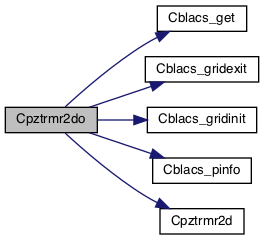
| void Cpztrmr2do | ( | ) |
| void Cpztrmr2do | ( | char * | uplo, |
| char * | diag, | ||
| int | m, | ||
| int | n, | ||
| dcomplex * | ptrmyblock, | ||
| int | ia, | ||
| int | ja, | ||
| MDESC * | ma, | ||
| dcomplex * | ptrmynewblock, | ||
| int | ib, | ||
| int | jb, | ||
| MDESC * | mb | ||
| ) |
Definition at line 292 of file pztrmr.c.
{
int dummy, nprocs;
int gcontext;
/* first we initialize a global grid which serve as a reference to
* communicate from grid a to grid b */
Cblacs_pinfo(&dummy, &nprocs);
Cblacs_get(0, 0, &gcontext);
Cblacs_gridinit(&gcontext, "R", 1, nprocs);
Cpztrmr2d(uplo, diag, m, n, ptrmyblock, ia, ja, ma,
ptrmynewblock, ib, jb, mb, gcontext);
Cblacs_gridexit(gcontext);
}
| void Csetpvmtids | ( | ) |
| void Czgerv2d | ( | ) |
| void Czgesd2d | ( | ) |
| void dispmat | ( | ) |
| void fortran_mr2d | ( | char * | uplo, |
| char * | diag, | ||
| int * | m, | ||
| int * | n, | ||
| dcomplex * | A, | ||
| int * | ia, | ||
| int * | ja, | ||
| desc_A | , | ||
| dcomplex * | B, | ||
| int * | ib, | ||
| int * | jb, | ||
| desc_B | |||
| ) |
Definition at line 262 of file pztrmr.c.
{
Cpztrmr2do(uplo, diag, *m, *n, A, *ia, *ja, (MDESC *) desc_A,
B, *ib, *jb, (MDESC *) desc_B);
return;
}
| void freememory | ( | ) |
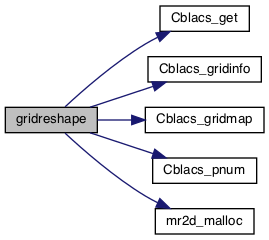
| static2 void gridreshape | ( | ) |
| static2 void gridreshape | ( | int * | ctxtp | ) |
Definition at line 671 of file pztrmr.c.
{
int ori, final; /* original context, and new context created, with
* line form */
int nprow, npcol, myrow, mycol;
int *usermap;
int i, j;
ori = *ctxtp;
Cblacs_gridinfo(ori, &nprow, &npcol, &myrow, &mycol);
usermap = mr2d_malloc(sizeof(int) * nprow * npcol);
for (i = 0; i < nprow; i++)
for (j = 0; j < npcol; j++) {
usermap[i + j * nprow] = Cblacs_pnum(ori, i, j);
}
/* Cblacs_get(0, 0, &final); */
Cblacs_get(ori, 10, &final);
Cblacs_gridmap(&final, usermap, 1, 1, nprow * npcol);
*ctxtp = final;
free(usermap);
}
| static2 void init_chenille | ( | ) |
| static2 void init_chenille | ( | int | mypnum, |
| int | nprocs, | ||
| int | n0, | ||
| int * | proc0, | ||
| int | n1, | ||
| int * | proc1, | ||
| int ** | psend, | ||
| int ** | precv, | ||
| int * | myrang | ||
| ) |
Definition at line 599 of file pztrmr.c.
{
int ns, nr, i, tot;
int *sender, *recver, *g0, *g1;
tot = max(n0, n1);
sender = (int *) mr2d_malloc((nprocs + tot) * sizeof(int) * 2);
recver = sender + tot;
*psend = sender;
*precv = recver;
g0 = recver + tot;
g1 = g0 + nprocs;
for (i = 0; i < nprocs; i++) {
g0[i] = -1;
g1[i] = -1;
}
for (i = 0; i < tot; i++) {
sender[i] = -1;
recver[i] = -1;
}
for (i = 0; i < n0; i++)
g0[proc0[i]] = i;
for (i = 0; i < n1; i++)
g1[proc1[i]] = i;
ns = 0;
nr = 0;
*myrang = -1;
for (i = 0; i < nprocs; i++)
if (g0[i] >= 0 && g1[i] >= 0) {
if (i == mypnum)
*myrang = nr;
sender[ns] = g0[i];
ns += 1;
recver[nr] = g1[i];
nr += 1;
assert(ns <= n0 && nr <= n1 && nr == ns);
}
for (i = 0; i < nprocs; i++)
if (g0[i] >= 0 && g1[i] < 0) {
if (i == mypnum)
*myrang = ns;
sender[ns] = g0[i];
ns += 1;
assert(ns <= n0);
}
for (i = 0; i < nprocs; i++)
if (g1[i] >= 0 && g0[i] < 0) {
if (i == mypnum)
*myrang = nr;
recver[nr] = g1[i];
nr += 1;
assert(nr <= n1);
}
}
| static2 int inter_len | ( | ) |
| int localindice | ( | ) |
| int localsize | ( | ) |
| int memoryblocksize | ( | ) |
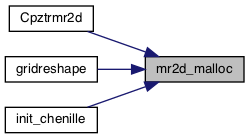
| void* mr2d_malloc | ( | ) |
| void paramcheck | ( | ) |
| int ppcm | ( | ) |
| int scan_intervals | ( | ) |
| void scanD0 | ( | ) |
| void setmemory | ( | ) |
| void zlacpy_ | ( | ) |